Yesterday’s Habits Are Holding Back AI Transformation: Lars Sudmann on Leading Through Uncertainty
Speaking at CxO Industry 2026, leadership advisor Lars Sudmann argued that the greatest obstacle to AI transformation is not the technology itself. It is the legacy of how organisations have learned to think, decide and operate.
Uncertainty Makes Leadership More Important
Leaders are being asked to make decisions amid accelerating AI development, geopolitical tension and emerging technologies whose commercial impact is still difficult to predict. Waiting for certainty may feel prudent, but Sudmann warned that organisations do not adapt automatically.
Opening his keynote at Professio’s CxO Industry 2026 event, he borrowed a line attributed to management thinker Peter Drucker.
“Only three things happen naturally in organisations: friction, confusion andunderperformance. Everything else requires leadership.”
–Peter Drucker
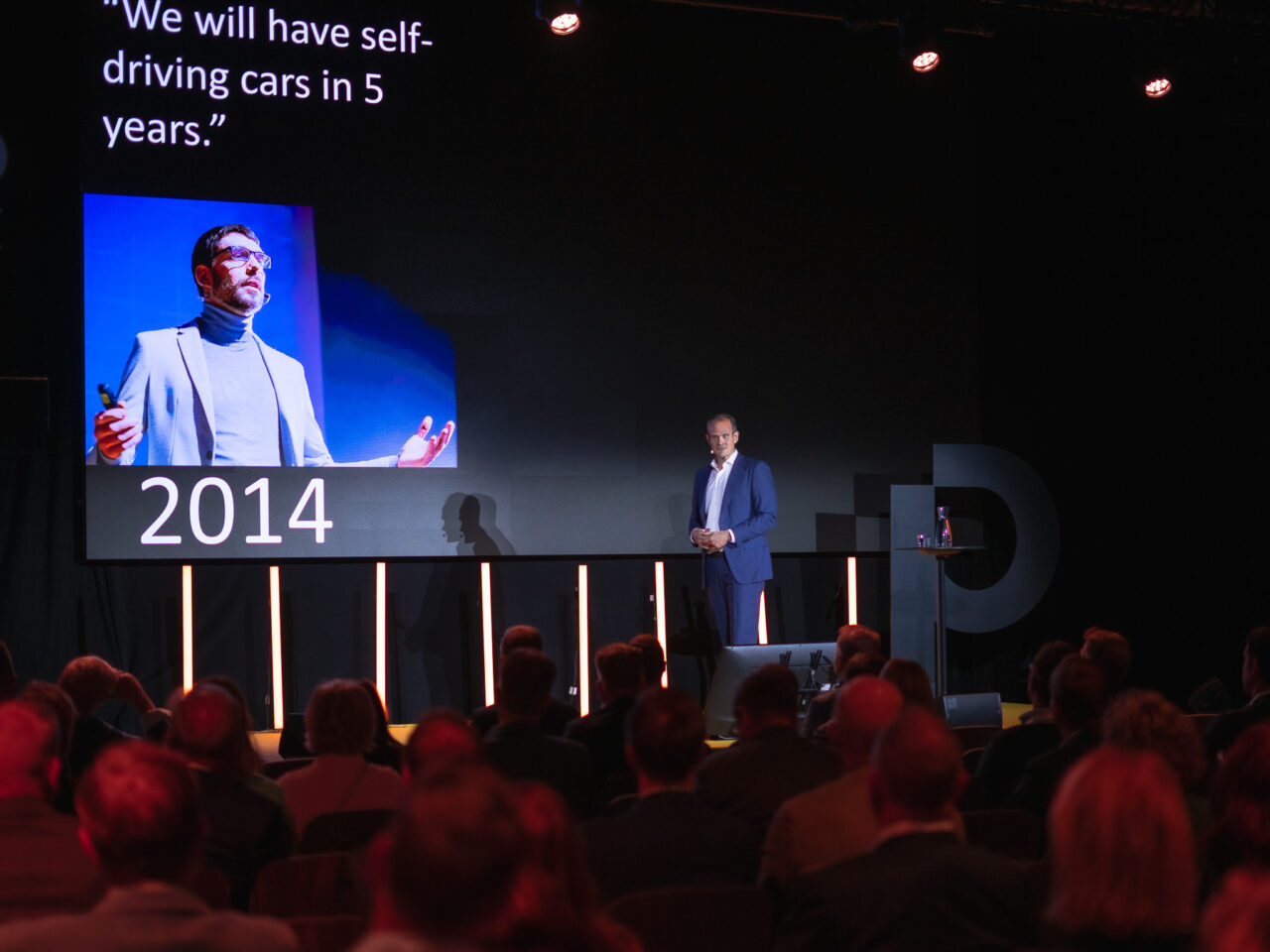
The challenge is to provide direction without pretending that the future is predictable. Sudmann recalled telling his young daughters in 2014 that they would never need driving licences because autonomous cars would arrive within five years. Both later began learning to drive.
For leaders, the lesson is not to stop anticipating change. It is to build organisations that can test assumptions and adjust when forecasts prove wrong.
The QWERTY Challenge
Sudmann described the central obstacle to AI transformation as the QWERTY challenge. The familiar keyboard layout was created for mechanical typewriters, yet it remained after the original technical constraints disappeared. Organisations carry similar path dependencies.
Processes, reporting structures and decision rights may continue because they are familiar—not because they are best suited to an AI-enabled organisation. This creates a widening gap: technology develops rapidly, while the organisation continues to implement yesterday’s operating model.
Experiment Beyond What Is Certain to Work
To break this pattern, Sudmann encouraged leaders to apply what he calls the spaghetti principle: throw ideas at the wall, observe what sticks and learn quickly from what does not.
“Become your own leadership lab, where you get into the rhythm of throwing things to the wall and seeing if it sticks.”
The principle applies beyond technology teams. Leaders can experiment with meetings, communication, AI prompts, decision processes and management practices. But genuine experimentation must include ideas whose outcome is uncertain.
“If you do an experiment and you know it’s going to work, it’s not an experiment. That’s just an implementation.”
Sudmann calls the bolder tests “red spaghetti”: experiments that challenge the assumptions an organisation normally protects. Not every idea should survive, but a portfolio without uncertainty is unlikely to produce meaningful transformation.
Leadership Starts with a Personal Code
Constant change can also create uncertainty fatigue. Sudmann therefore urged leaders to define a personal impact code: a small number of statements describing how they lead, what they expect from others and what others can expect from them.
One principle he highlighted was “high autonomy, high alignment”. Autonomy is valuable only when people share a clear direction. Another was that, when dealing with exponential change, the right time to act may be when action still feels too early.
“How would the leader I want to be handle the things I’m facing today?”
A few minutes of daily reflection can help leaders respond deliberately instead of being pulled back into inherited habits. Sudmann’s final challenge was practical: choose one concrete change to implement in the next four weeks—and make sure it does not disappear into the urgency of Monday morning.
AI transformation will not be achieved by technology alone. It depends on leaders who can question yesterday’s assumptions, address uncertainty openly and turn learning into action.
Experience the Full Keynote
This article offers a glimpse into Lars Sudmann’s keynote at CxO Industry 2026. The conversation on transformational leadership, AI and industrial competitiveness continues at CxO Industry 2027.
Industry Circle brings together a distinguished group of industry leaders from leading Nordic organisations, united in a trusted and thoughtfully cultivated community. As a member, you are invited to experience a carefully curated calendar of gatherings, refined conversations, and forward-looking insights — all designed to keep you at the forefront of an ever-evolving business landscape.