Europe’s AI Dependency Is Becoming a Security Risk: Toomas Hendrik Ilves on the Future of Digital Government
Speaking at GovTech, the former President of Estonia argued that agentic AI could transform public services around citizens’ needs. But unless Europe builds technological capacity of its own, the next generation of government may depend on infrastructure controlled by the United States or China.
Digital Government Must Move Beyond Digital Paper
Governments across Europe have spent decades digitising public services. Yet according to Toomas Hendrik Ilves, much of this work has simply transferred old administrative processes into a digital format.
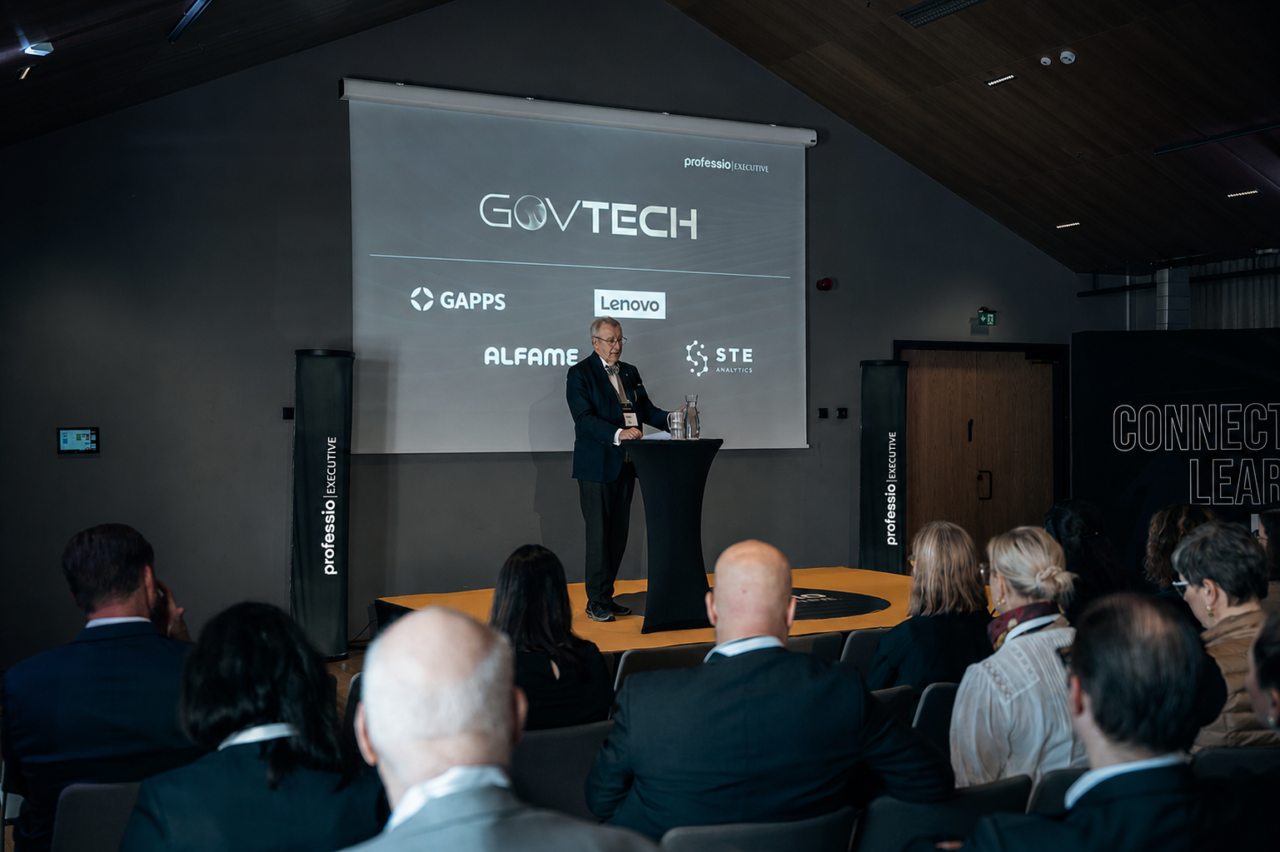
Speaking at Professio Executive’s GovTech event, the former President of Estonia argued that online forms and downloadable documents do not by themselves constitute digital government.
Doing this with PDFs is not digital governance. It is basically digital paper.
The underlying process often remains unchanged: citizens must identify the correct authority, find the relevant service, complete an application and follow its progress through several administrative stages.
For Ilves, the next transformation begins when public services stop reflecting the structure of government and start organising themselves around people’s lives.
Agentic AI Could Invert the Relationship Between Citizens and Government
Agentic AI brings together the reasoning capabilities of large language models with tools that can access information, communicate with other systems and initiate actions.
In public services, this could enable AI agents to coordinate an entire process instead of merely answering a question or directing a citizen to the correct form.
“Agentic AI works by inverting the relationship between citizens and bureaucracy.”
Ilves illustrated the idea through a citizen whose home has been damaged in a storm. Today, that person may need to contact insurers, housing authorities, permit services and utility companies separately. In an agentic system, the citizen could describe what has happened and allow coordinated services to organise the necessary response.
The same principle could apply to the birth of a child, applying for unemployment support or renewing a licence. Citizens would no longer need to understand which department is responsible for each step.
“Services should flow around people’s lives rather than forcing them to go through bureaucratic mazes.”
The Goal Is Better Outcomes, Not Just Faster Processes
he potential of agentic government extends beyond convenience. AI agents could dynamically sequence tasks, remove bottlenecks and monitor regulatory compliance continuously instead of identifying failures only after harm has occurred.
This would represent a shift in how government performance is understood.
“The transformation is from doing things the right way – following procedures perfectly – to doing the right things and achieving the outcomes citizens actually need.”
Ilves emphasised that the purpose is not to remove people from public administration. Automating routine tasks could allow public-sector professionals to focus more of their time on judgement, empathy and strategic thinking.
However, systems that can make recommendations, update records and initiate transactions also introduce a new level of authority. Traditional AI governance has mainly focused on whether an output is accurate, fair or compliant. Agentic systems require governments to supervise not only what AI says, but also what it is allowed to do.
Government Infrastructure Must Be Ready for Autonomous Action
Agentic public services cannot be built on fragmented information and disconnected systems.
Ilves argued that governments will need more reliable data, secure digital identities, interoperable services, clearly defined interfaces and new mechanisms for registering and supervising AI agents.
“As AI shifts from generating answers to initiating decisions, governance must evolve from policy alignment to sustained operational control.”
The question of responsibility becomes particularly important when an agent operates across organisational boundaries. Governments must define where automated authority ends, when human approval is required and who remains accountable for the final decision.
For executive teams in the public sector, AI transformation is therefore not simply a technology programme. It requires the redesign of workflows, accountability and the relationship between institutions and citizens.
Europe’s AI Dependency Is a Question of Sovereignty
The most serious challenge, according to Ilves, is geopolitical.
Europe is planning to make AI part of government while lacking the computing capacity, infrastructure and investment needed to develop and operate leading systems independently. In practice, this leaves European organisations dependent on technology originating primarily in the United States or China.
If we do not invest massively in building out AI, we will be forced to use either US systems or Chinese systems.
“If we do not invest massively in building out AI, we will be forced to use either US systems or Chinese systems.“
Chinese systems raise questions about censorship, data integrity and state access to information. Reliance on US technology carries a different risk: services ultimately remain subject to the political decisions and jurisdiction of another country.
For private companies, losing access to a technology platform can be highly disruptive. For governments operating critical services, the consequences could be far more serious.
The absence of digital control and sovereignty becomes a genuine security issue for Europe.
Ilves warned that countries such as Finland and Estonia cannot base their long-term security on the hope that political conditions elsewhere will always remain favourable.
Europe Must Build the Capacity to Choose
Despite the risks, Ilves does not see avoiding AI as a realistic option. Agentic systems are developing rapidly, and countries that fail to engage with them risk falling further behind in productivity, public-service quality and technological expertise.
Estonia estimates that the comprehensive digitisation of government has generated an annual economic benefit equivalent to approximately two per cent of GDP. Agentic AI could take this transformation further by redesigning end-to-end processes rather than merely making individual administrative tasks faster.
The strategic choice is therefore not between adopting AI and remaining free of risk. It is between building the ability to use AI on Europe’s own terms and becoming increasingly dependent on systems controlled elsewhere.
“Ultimately, whoever is the dominant power in AI can potentially run everybody else. I do not think we in Europe want to become vassals of either the United States or China.”
For European leaders, digital sovereignty is becoming inseparable from public-sector reform. The next generation of government must be innovative enough to meet citizens’ expectations, but resilient enough to remain accountable to the societies it serves.
Experience the Full Keynote
This article offers a glimpse into Toomas Hendrik Ilves’s keynote – but the conversation does not stop there.
GovTech brings together public-sector decision-makers and technology leaders to explore how AI, data and digital sovereignty are reshaping government, public services and societal impact.
Toomas Hendrik Ilves served as president of Estonia from 2006–2016. Ilves is renowned for helping make Estonia one of the most digitally advanced nations through innovative policies that invested heavily in the future.
Ilves was born to Estonian refugees and raised in the United States. He holds a BA from Columbia University and an MA from the University of Pennsylvania. He moved to Munich in 1984 to work as an analyst and researcher for Radio Free Europe, eventually becoming Director of the radio’s Estonian Service.
From 1993–1996, he served as Estonia’s ambassador to the United States. In 1996, he was appointed the country’s Minister of Foreign Affairs, a post he held until 1998, and again from 1999 to 2002. During this period, he played a key role in steering Estonia toward membership in the EU and NATO, which it achieved in 2004.
He ran for the presidency of Estonia as a joint candidate of the Social Democratic, Conservative, and Liberal parties and was elected in 2006 and re-elected in 2011.
Ilves used his office to further the country’s leadership in digital governance as well as in cybersecurity. Since leaving office, Ilves spent three and a half years as a distinguished visiting fellow at Stanford University and the Center for Advanced Study in the Behavioral Sciences, while lecturing around the world on the digitization of governance and public services.
Over the past five years, Toomas Hendrik Ilves has remained an influential voice in international policy, technology, and European affairs, speaking and writing extensively on digital governance, cybersecurity, trans-Atlantic relations, and Europe’s technological competitiveness. He has held fellowships and advisory roles at institutions such as Stanford University and the Hoover Institution, while serving on several international councils and boards focused on technology and security. He has also been teaching courses on foreign policy and digitalisation at the University of Tartu in Estonia.
A place reserved for you
HR Circle brings together a distinguished group of HR leaders and executives from leading Nordic organisations, united in a trusted and thoughtfully cultivated community. As a member, you are invited to experience a carefully curated calendar of gatherings, refined conversations, and forward-looking insights — all designed to keep you at the forefront of an ever-evolving business landscape.